






Adobe Color
Explore Adobe Color Platform (formerly...
标签:interface designAdobe Color Adobe Color 2026 Update Adobe Color Creative Cloud Sync Adobe Color Free Color Palette Tool Adobe Color Image Color Extraction Adobe Color Accessibility Contrast Check Adobe Color's Future AI Strategy Adobe Color Core Features Adobe Color Community Theme Sharing Adobe Color Color Blindness Simulator The Origins and Evolution of Adobe Color Adobe Color Trend Gallery Adobe Color Wheel Harmony Rules Adobe Kuler Accessible Color Scheme Gradient Generation Color Matching Tool Color Theme Color WheelPlatform Origins and Strategic Evolution Adobe ColorOriginally named Adobe Kuler, it launched in 2007 as a community-driven color theme sharing tool to help designers explore and share color palettes. Officially rebranded as Adobe Color in 2014, it became deeply integrated with Creative Cloud, forming a vital part of the Adobe ecosystem. The platform evolved from a simple color wheel tool into a comprehensive online color palette platform, supporting color extraction from images, trend exploration, and accessibility checks. After 2020, advanced accessibility tools were introduced, supporting colorblind simulation and contrast checks to promote inclusive design. By 2026, Adobe Color continued optimizing its Trends Galleries, integrating inspiration from Behance and Adobe Stock, and enhancing synchronization with applications like Adobe Express and Photoshop. This empowers designers to rapidly iterate color schemes in the AI era.

Adobe Color Themes | How to Create and Use Them for Color Grading in …
Core Functions and Service Ecosystem Adobe ColorAt its core is an interactive color wheel that supports multiple harmony rules (complementary, analogous, triadic, etc.) to generate professional color schemes.
- Create TopicManually adjust the color wheel or extract five dominant colors from an uploaded image, with support for gradient generation.
- Explore the CommunityBrowse millions of user-shared themes, search by keywords (such as “mystery” or “vibrancy”) or concepts, and incorporate Adobe Sensei AI recommendations.
- Trend GalleryCurated from Behance and Adobe Stock, offering trending industry color palettes.
- Accessibility ToolsContrast Checker and Color Blindness Simulator, supporting WCAG standards to ensure design inclusivity.
- Repository synchronizationSave themes automatically sync to Creative Cloud Libraries, ready to use in Photoshop, Illustrator, Express, and more.
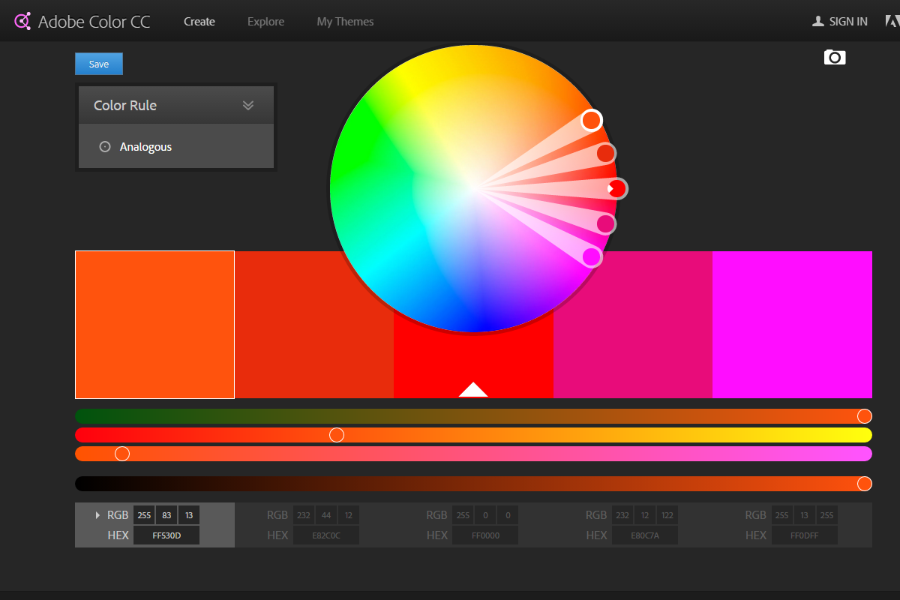
Adobe Color CC | Software Reviews & Alternatives
Technology Architecture and Innovation Strategy The platform is built on web technology and offers free access (color.adobe.com), with basic features available without a subscription. It features deep integration with Adobe Sensei AI, providing intelligent search and recommendations. Accessibility features simulate three types of color blindness (such as red-green color blindness) and flag conflicting colors for real-time adjustments. It supports conversion between multiple modes including RGB, CMYK, and HSV, making it suitable for both print and digital design.
Business Model and Commercial Value Adobe Color is completely free, serving as an entry point to Creative Cloud to attract designers to sign up for subscriptions. Its value lies in its closed-loop ecosystem: generated color palettes seamlessly import into paid applications, boosting workflow efficiency. Serving millions of users worldwide, many Fortune 500 brands rely on its trend data to formulate visual strategies. Community sharing fosters creative exchange, indirectly driving Adobe product sales.
Globalization Impact and Social Responsibility Adobe Color drives global design inclusivity by empowering designers to create works accessible to colorblind users through barrier-free tools, impacting web, app, and brand design. Its trend features reflect cultural diversity and support localized inspiration. Through this platform, Adobe promotes color theory education, offering free resources to benefit students and emerging designers, thereby advancing digital creative equity.
Future Outlook and Direction of Development After 2026, Adobe Color will deepen AI integration, such as smarter image extraction and personalized recommendations, while leveraging Adobe Firefly generative AI to expand color possibilities. In response to design tool competition, it will focus on multisensory trends (textures, saturated colors) and sustainable design. The platform will continue emphasizing accessibility and community collaboration, providing designers with a complete color solution from inspiration to implementation.

Adobe Logo and Symbol, Meaning, History, PNG, Brand
concluding remarks From Kuler to Adobe Color, this free online tool has revolutionized designers' color palette workflows. With over ten million community themes and industry-leading accessibility features, Adobe Color is the premier platform for exploring color inspiration—whether you're a professional designer or creative enthusiast. In the AI-driven design era of 2026, it will continue bridging creativity and technology, empowering users to craft visually impactful and inclusive work.
数据统计
数据评估
From the WEB3 editorial team on this siteAdobe ColorAll content originates from the internet. We do not guarantee the accuracy or completeness of external links. Furthermore, the destination of these external links is not under the actual control of the WEB3 Editorial Department. At the time of inclusion on January 2, 2026, at 3:30 PM, the content on the linked webpage was compliant and lawful. Should any subsequent content on the webpage violate regulations, please contact the website administrator directly for removal. The WEB3 Editorial Department assumes no responsibility whatsoever.
相关导航
Pixlr Detail: free online AI photo editing platform founded in 2008, browser zero installation alternative to Photoshop. support Pixlr E advanced layer editing, Pixlr X quick beautification, AI generated fill/extension/object removal, background removal, intelligent denoising. 2026 Pixlr Suite latest analysis, unlimited AI credits paid version, suitable for Bloggers, designers & remote teams for efficient retouching.
Canva is an online design platform with 125 million monthly activities in the world since it was founded in 2013. It supports a huge number of Chinese templates, 300+ Chinese fonts, AI dialogue generation (one sentence out of the picture, out of the poster), Magic Studio all-round tools, brand center and real-time collaboration. 2026 design trend report latest analysis, help e-commerce, social media and enterprise efficient visual creation.
 Chinese (China)
  Chinese (Hong Kong)
  English
  German
  Spanish
  French
  Portuguese
  Japanese
  Korean
  Russian
  Indonesian